Anna Simon · 8 October 2026
Exploring Data Sovereignty Impacts on Transatlantic Small Business Trade Routes Post-Red Sea Changes
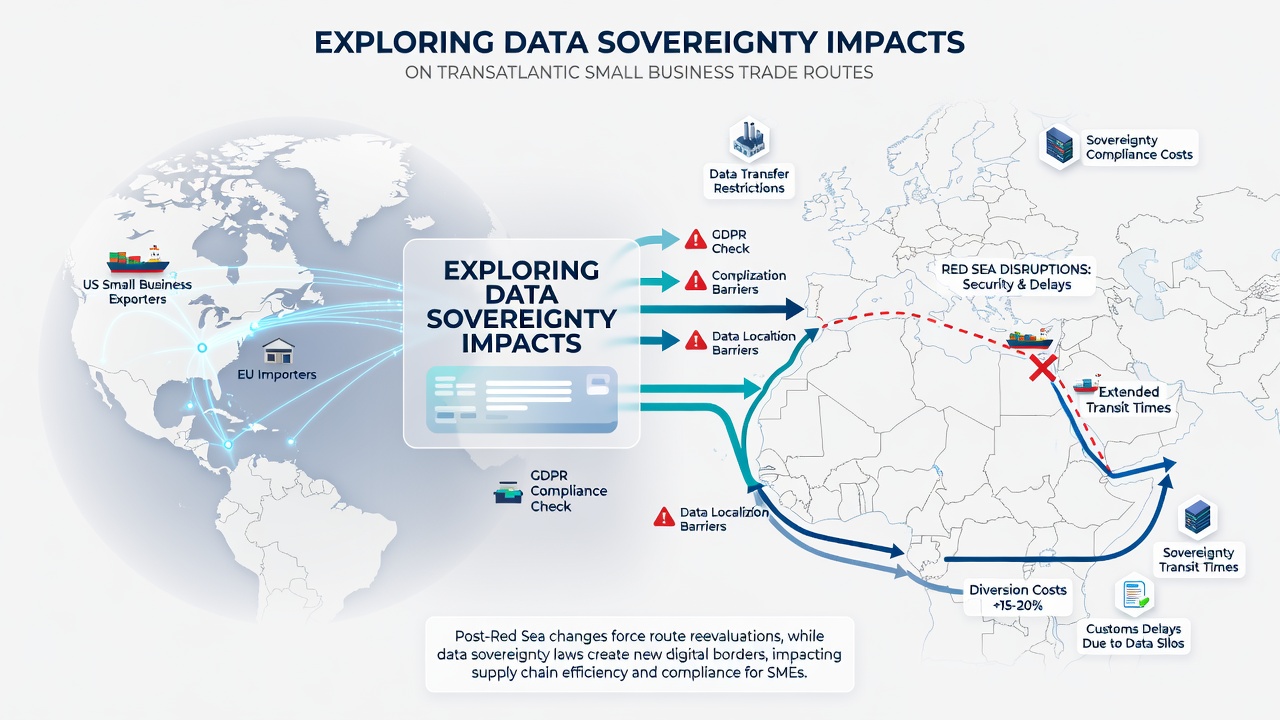
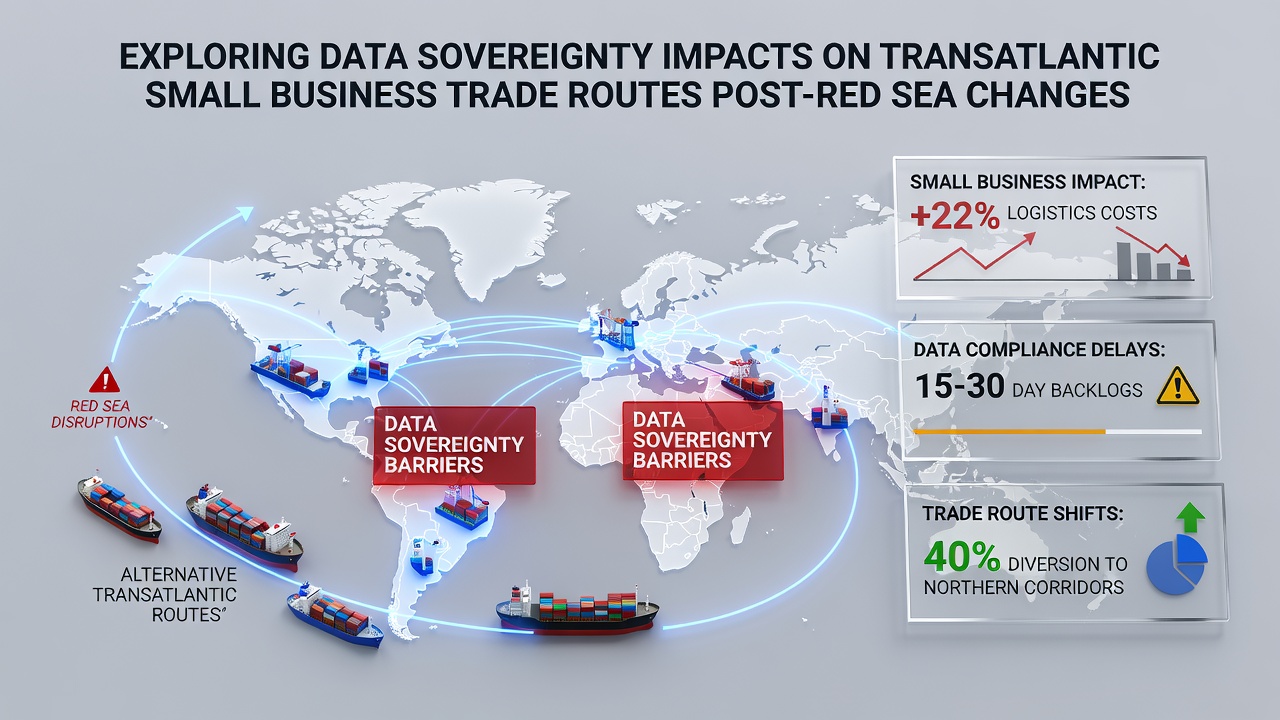
Data sovereignty rules require that information generated during cross-border transactions stays within designated jurisdictions, and these requirements now intersect directly with the longer shipping lanes that emerged after Red Sea disruptions forced vessels around the Cape of Good Hope. Small businesses handling transatlantic goods face new layers of compliance when customs declarations, inventory records, and customer data must route through approved servers while physical cargo travels extended distances. Observers note that the combination produces measurable delays in order processing because companies must verify data residency before releasing shipments from port systems.
Red Sea Route Adjustments and Resulting Trade Patterns
Since late 2023, attacks in the Red Sea prompted carriers to divert container traffic, adding roughly 10 to 14 days to voyages between Europe and North America via the southern Atlantic corridor. Figures from the International Maritime Organization show that by October 2026 the average transit time from Rotterdam to New York had stabilized at 32 days compared with 18 days on the Suez route. Small exporters in both regions adjusted inventory strategies, yet the physical changes also triggered corresponding adjustments in digital supply-chain platforms that track those same containers.
Those platforms often rely on cloud services subject to data-localization statutes in the European Union and the United States. When a shipment’s sensor data crosses jurisdictions without explicit consent under local rules, companies encounter automatic holds at digital checkpoints that mirror physical port inspections. Researchers at the OECD documented a 17 percent rise in administrative queries filed by firms with fewer than 50 employees during the first half of 2026, many tied to mismatched data-storage locations.
Data Sovereignty Regulations Affecting Small Operators
The EU’s General Data Protection Regulation and the US CLOUD Act create overlapping but distinct obligations for any firm moving commercial records across the Atlantic. A Canadian small business selling specialty machinery to German buyers, for example, must store transaction logs on servers inside Canada or the EU while also satisfying US requirements if any portion of the order travels through American logistics software. Compliance teams at the Canadian Chamber of Commerce reported that average legal-review costs for such transactions climbed from 1,200 CAD in 2022 to 2,800 CAD by October 2026.
Smaller operators frequently lack dedicated compliance staff, so they turn to third-party platforms that automatically segment datasets according to current regulations. These platforms add subscription fees that range between 150 and 400 USD monthly, according to a 2026 survey conducted by the US Small Business Administration. The added expense compounds when carriers alter routes again, because each change can shift which national data rules apply to real-time tracking feeds.
Integrated Logistics and Digital Documentation Flows
Modern bills of lading now exist as electronic records stored in distributed ledgers, and several jurisdictions insist these records remain inside their borders. When a vessel reroutes around Africa, the ledger entries update through multiple satellite links, each potentially subject to different sovereignty statutes. The World Trade Organization’s 2025 annual trade report recorded that electronic documentation processing times for small transatlantic shipments lengthened by an average of 41 hours once rerouting became standard practice.
One logistics provider based in Portugal implemented a dual-server architecture so that shipment data stays mirrored between Lisbon and Boston facilities. The setup satisfied both EU and US rules yet required an initial capital outlay of 85,000 EUR, a figure that smaller competitors without similar resources have struggled to match. Trade associations in the Baltic region have since formed consortiums that pool server capacity, allowing members to share compliance infrastructure without individual hardware purchases.
Regional Variations in Enforcement and Support Programs
Enforcement intensity differs across Atlantic ports. Rotterdam customs authorities began automated scans of inbound data packets in March 2026, flagging any record whose metadata indicates storage outside permitted zones. In contrast, the Port of Halifax relies on periodic audits rather than real-time checks, giving Canadian exporters a slightly longer window to correct residency issues. The Australian Productivity Commission’s comparative study of port procedures, released in September 2026, placed these two approaches at opposite ends of a spectrum that also includes the more notification-based system used in US East Coast facilities.
Government grant programs have emerged to offset some costs. The European Commission’s SME Digital Resilience Fund disbursed 42 million EUR in the second quarter of 2026 specifically for data-sovereignty upgrades among firms engaged in transatlantic commerce. On the North American side, Industry Canada’s Trade Digitalization Initiative approved matching funds up to 25,000 CAD per applicant for similar infrastructure investments.
Conclusion
Transatlantic small-business trade continues to absorb the combined effects of extended physical routes and stricter data-residency mandates. Documentation systems must now satisfy multiple overlapping statutes while cargo travels longer distances, producing measurable increases in both time and expense. Regional support programs and shared infrastructure arrangements offer partial relief, yet the underlying requirement that digital records remain within approved borders persists alongside the altered shipping geography. Trade data compiled through October 2026 indicate that these dual pressures remain central variables shaping operational decisions for smaller exporters on both sides of the Atlantic.