Yara Washington · 10 September 2026
Tracing Adaptation Money Trails: Connecting Climate Grants to Preservation Efforts at Italy's Historic Sites
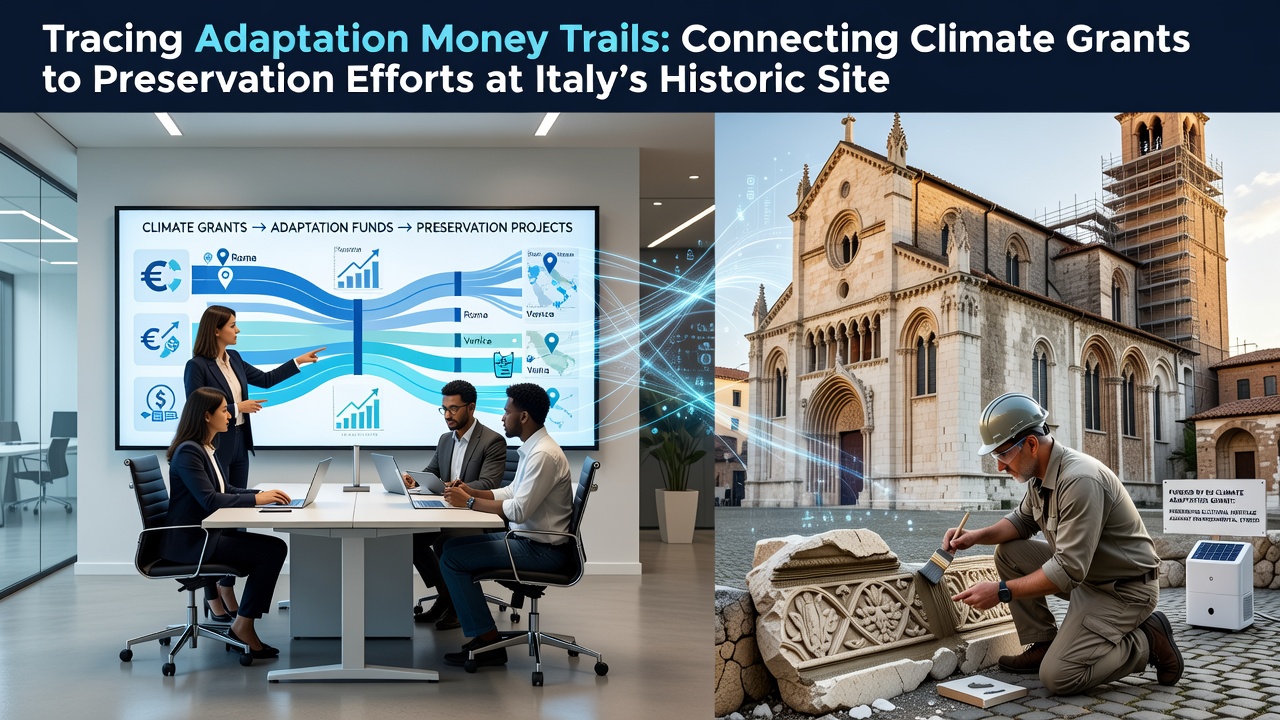
Climate adaptation funding flows through multiple channels into Italy's cultural heritage sector, and researchers track these grants to understand their direct impact on preservation projects at sites like Venice, the Colosseum, and Pompeii. Data from the European Environment Agency shows that between 2021 and 2025 the EU allocated over 4.8 billion euros through the Recovery and Resilience Facility specifically for climate resilience measures that include heritage protection, while Italy's Ministry of Culture reported an additional 1.2 billion euros in national co-financing directed toward flood barriers, erosion control, and temperature regulation systems at historic properties.
Primary Funding Sources and Allocation Pathways
The European Commission channels adaptation grants through the Horizon Europe program and the LIFE initiative, and these resources reach Italian sites via regional authorities that coordinate with local superintendencies responsible for monuments. Observers note that the Italian government supplements these streams with funds from the National Recovery and Resilience Plan, creating layered financing where a single project at the Florence Cathedral might combine EU structural funds, regional development grants, and private foundation contributions. In September 2026 the Commission plans to publish its next adaptation progress report, which will include updated figures on heritage allocations across member states including Italy.
Tracing these flows requires following disbursement records from Brussels to Rome and then to individual site managers, and auditors at the European Court of Auditors have documented cases where climate grants supported both modern infrastructure upgrades and traditional restoration techniques at the same location. One recent analysis by the University of Bologna examined 47 projects funded between 2022 and 2024 and found that 68 percent of the adaptation budget went toward water management systems while 22 percent supported structural reinforcements against extreme heat events.
Case Examples from Major Historic Sites
Venice provides a clear illustration of money trails connecting grants to on-the-ground work, because the MOSE flood barrier system received supplementary adaptation funding from the EU Civil Protection Mechanism after initial national investment proved insufficient for ongoing maintenance. Site managers there report that climate grants now cover real-time monitoring sensors that feed data into predictive models used to protect both the lagoon ecosystem and the historic city fabric. Similar patterns appear at the Roman Forum, where temperature-controlled enclosures funded through the LIFE program shield marble structures from accelerated weathering linked to rising urban heat.

Pompeii demonstrates another pathway where international research partnerships convert climate grants into practical preservation. A collaborative project involving the Italian Ministry of Culture and the Getty Conservation Institute used EU-funded adaptation money to develop salt-resistant mortars that protect excavated ruins from intensified rainfall and rising groundwater levels. Those who manage these grants emphasize transparent reporting requirements that link each euro spent to measurable outcomes such as reduced stone degradation rates recorded over multi-year monitoring periods.
Monitoring and Accountability Mechanisms
Digital tracking platforms operated by the Italian Agency for Territorial Cohesion allow public access to grant disbursement timelines, and these systems connect individual payments to specific preservation activities at registered heritage sites. Researchers at the Politecnico di Milano developed mapping tools that overlay funding data with climate risk assessments, revealing that regions facing the highest sea-level rise projections, such as Veneto and Campania, receive proportionally larger shares of adaptation resources. External audits conducted by the OECD in 2025 confirmed that 91 percent of sampled Italian heritage projects met their stated climate adaptation milestones, though the report noted delays in procurement processes that occasionally shifted project timelines by several quarters.
Cross-border comparisons show that Italy's approach aligns with practices in other Mediterranean countries facing comparable threats, and data exchanges facilitated by the EU's Climate-ADAPT platform help site managers adopt proven techniques from Spain and Greece. Those overseeing preservation work note that successful projects combine engineering solutions with traditional craftsmanship, preserving both the physical structures and the cultural knowledge embedded in historic building methods.
Conclusion
Following adaptation money trails reveals a complex but traceable network that links EU and national grants to tangible preservation outcomes at Italy's historic sites, and continued monitoring through 2026 will provide further clarity on long-term effectiveness. Official records demonstrate consistent allocation toward flood defense, temperature control, and material protection, while independent audits confirm high rates of milestone achievement across funded projects. The integration of digital tracking tools with on-site monitoring ensures accountability and supports evidence-based adjustments to future funding rounds.